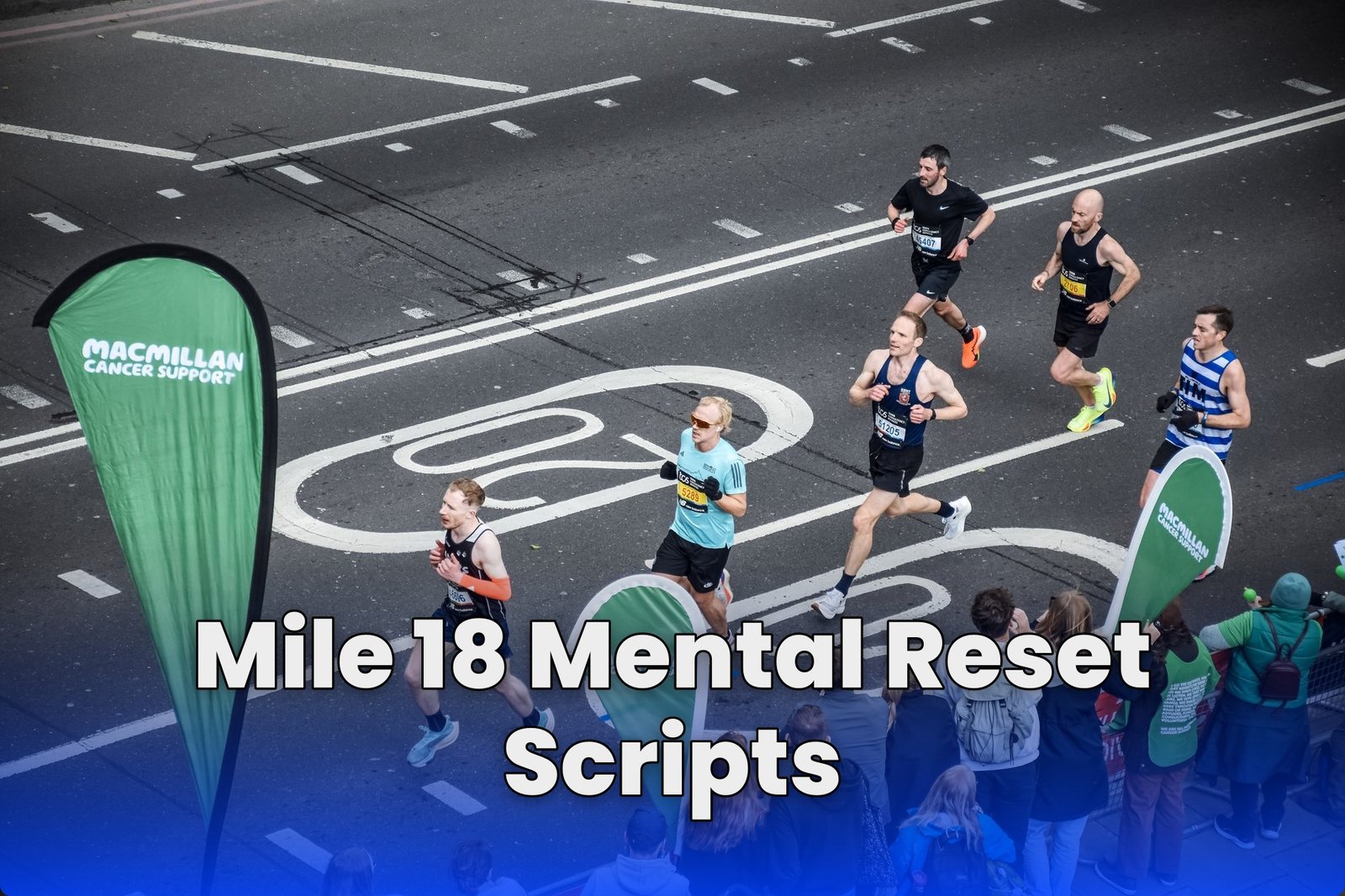
Mile 18 mental reset scripts give you short words to use when the London Marathon starts feeling too large to manage. The best line is usually not a grand promise about reaching the finish. It is a small instruction that brings your attention back to the next mile, landmark, breath, or sensible decision.
At that point, you have about 8.2 miles left, but repeating that distance can make fatigue feel bigger. Use “I only need to handle this mile,” then move your focus to one short section. If the route feels overwhelming, aim for a landmark such as Limehouse and reassess when you get there.
These prompts do not replace pacing, fueling, or medical judgment. They help you respond to tired legs and anxious thoughts without letting one difficult moment decide what the rest of the race means.
Key takeaways
- The watch is not the decision-maker near Canary Wharf when its pace jumps; hold the effort that matches your breathing and stride instead of surging.
- Panic calls for a brief reset: spend thirty seconds settling and thirty seconds re-engaging, but stop or seek help for unusual symptoms.
- A practiced fueling plan still applies when fatigue takes over; take the planned fuel at the planned point rather than waiting for hunger.
- Jaw, shoulders, hips, and rhythm give you four quick form checks when negative thoughts take over; keep the same effort instead of using looser form as a reason to speed up.
Settle the Race Into the Next Section
At mile 18, use “I only need to handle this mile” instead of “I have to finish the marathon.” The line gives your mind one task it can hold, rather than asking it to solve the entire finish while your legs are already tired.
Use the same smaller focus when one mile still feels too large:
- “Get to the next landmark.”
- “Stay with this short section.”
- “Handle the next sensible decision.”
A landmark gives you something you can see and reach. “Get me to Limehouse, then reassess” turns the course into a clear target without promising that everything afterward will feel easy.
Limehouse comes several miles after Canary Wharf, so use it as a checkpoint rather than a finish-line substitute. When you reach it, check your effort, breathing, form, and fueling plan, then choose the next short section. The aim is not to convince yourself that the remaining miles are painless. It is to stop your mind from carrying all of them at once.
Expected Fatigue and Warning Signs
Fatigue can produce a frightening thought without necessarily indicating a real problem. When the effort rises, say, “This is difficult, not dangerous; stay calm and keep moving.” The words acknowledge expected strain, but they do not dismiss warning signs or tell you that every sensation is harmless.
Stop and seek help for chest pain, fainting, severe breathing trouble, confusion, or an injury that changes your stride. Normal late-race heaviness feels hard, but it does not automatically mean the race is lost.
A thought such as “I’m falling apart” can be answered with “My body is tired, and I can still run the next section.” That separates a fact from a prediction. Your body may be tired, but you still need to decide whether the next section is manageable.
Short wording is easier to repeat without disturbing your breathing rhythm. A useful pattern is:
- Name the fact.
- Remove the panic.
- Continue with one action.
For example, say, “Tired legs, calm breath, keep moving.” If the feeling changes from ordinary fatigue to a serious symptom, stop using the script and get medical help.
Reset Your Body Before You Argue With Your Thoughts
A tired mind often gets louder when your body tightens. Use “Relax the jaw, drop the shoulders, lift the hips, and find the rhythm” as a quick moving check rather than stopping to rebuild your entire running form.
Start with the jaw: unclench it and let your face soften. Drop your shoulders away from your ears, lift your hips enough to stand tall, and return your attention to an even running rhythm. Each cue gives you a physical job, while negative thoughts ask you to debate the future.
The check takes only a few seconds. After it, notice what changed. If your breathing settles and your stride feels less cramped, keep running at the same effort; better form is not a reason to speed up at mile 18.
Confidence is not required for these actions. You can feel doubtful and still release your jaw, or feel exhausted and still lower your shoulders. The purpose is to give your attention something specific to do before the thought grows larger.
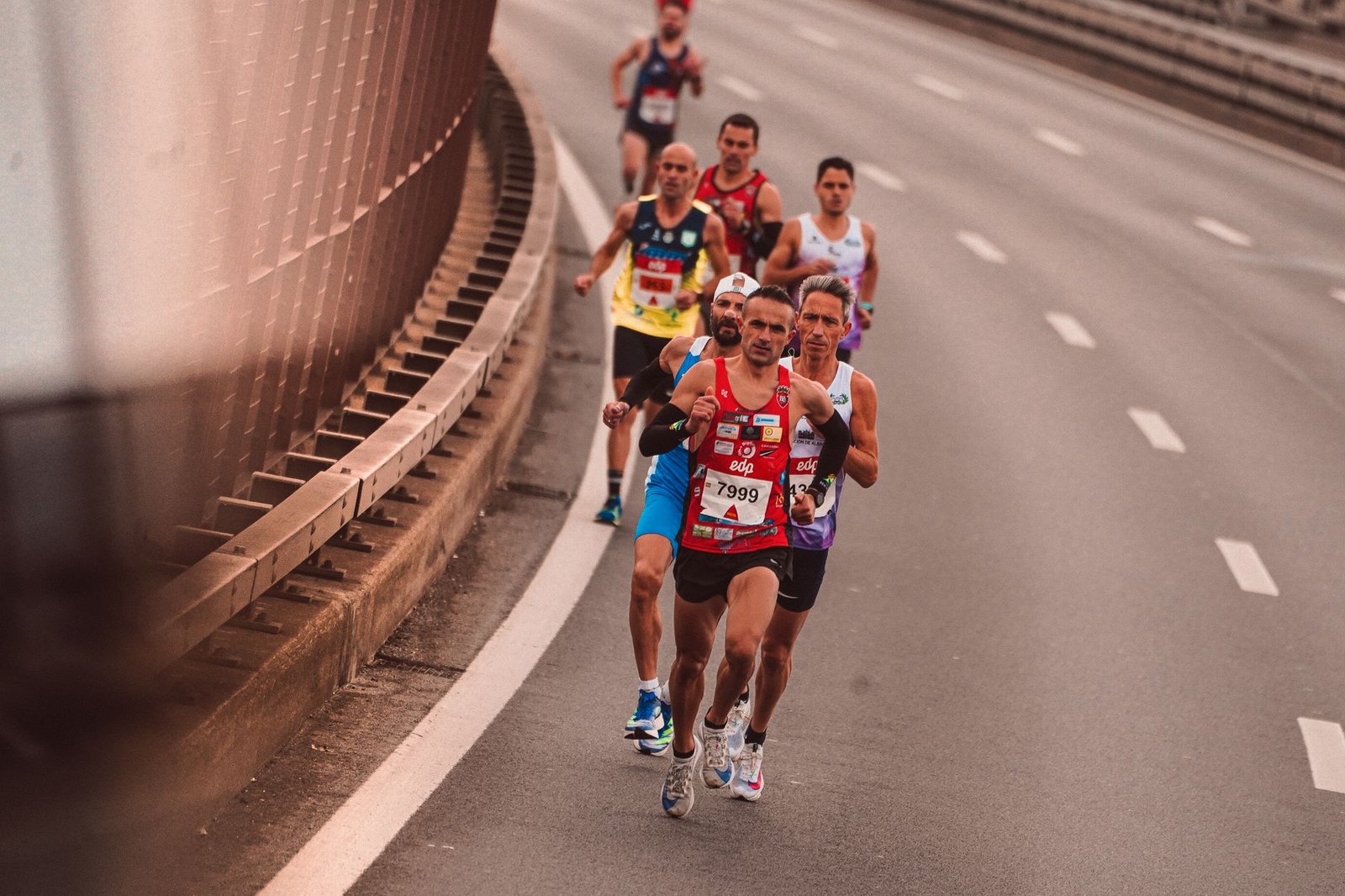
Diverse male athletes racing in a city marathon with dynamic motion.
Run by Effort When the Watch Becomes Unclear
A single watch split cannot tell you the whole truth about your pace. Around tall buildings in Canary Wharf, GPS readings can become unreliable, and an instantaneous number may jump even when your effort has not changed.
Say, “Run by effort, not by one watch split.” Judge the effort you can actually feel: notice whether your breathing is controlled, whether your stride remains steady, and whether you can keep the current pace without forcing it.
Do not chase a sudden slow reading by surging. A small tracking error can become a real pacing mistake if you react by running harder. When the watch repeatedly shows a number that does not match your breathing and stride, stop treating that number as the decision-maker.
| Situation | Script | Next action |
|---|---|---|
| GPS pace jumps near tall buildings | “Run by effort, not by one watch split.” | Hold controlled effort |
| The race feels too large | “Get to the next landmark.” | Run to the next visible target |
| Your legs feel tired | “My body is tired, and I can still run the next section.” | Continue if symptoms stay normal |
Effort is not a perfect measurement either. Heat, hills, wind, fatigue, and crowding can all change how it feels. It remains useful when the watch becomes noisy because it reflects the pace and form you can actually sustain.
Use a Controlled Reset When Panic Starts
Panic can make you speed up, stop suddenly, or grab for a desperate change in pace. Use “Thirty seconds to settle, then thirty seconds to re-engage.” The timed structure gives you a short pause without turning the rest of the race into an argument.
For the first thirty seconds, soften your hands, lower your shoulders, and let your breathing become quieter. Keep moving at a controlled pace if you can do so safely, but check for unusual symptoms before trying to re-engage. Stop and seek help when a medical problem may be developing; do not use the reset to force yourself through serious symptoms.
For the next thirty seconds, return your attention to one running decision. Check your breathing, stride, effort, and the next landmark. If running still feels manageable, continue without a sudden surge.
Use the sequence as written:
- Thirty seconds to settle.
- Thirty seconds to re-engage.
- One sensible decision after the reset.
The point is to return to a pace and form you can manage, not to prove that you are still fresh. A late-race surge may feel brave, but it spends energy when fatigue is already high.
Short timed resets may work better than long motivational speeches when panic narrows your attention. Give yourself one minute of clear work, then judge whether continuing is safe.
Answer Repeating Negative Thoughts With Neutral Facts
A repeating thought does not become true because it keeps returning. Answer it with “Tired legs, steady breathing, next mile.” The wording stays factual, short, and tied to what you can observe.
If you want more distance from the fear, use your name: “[Name], you trained for this; stay with the next step.” Speaking to yourself as “you” can make the thought feel like an instruction you can evaluate, not a command you must obey.
Use the name once, then return to the next physical task. Keep your breathing steady, check your foot strike, or run to the next landmark. The sentence helps only when it directs you back to an action you can take.
At mile 18, you do not need to feel confident; you need to keep making the next sensible decision. That may mean slowing down, drinking, taking fuel, adjusting your form, or getting help.

Athlete hydrating with water during a marathon run outside.
Avoid building a long speech in your head. Pick one line and repeat it at the same points in the race:
- After a difficult patch of road
- When a negative thought repeats
- Before you make a pacing or fueling decision
Neutral words can feel less exciting than a promise to be unstoppable. They do not ask you to believe something your body is not telling you.
Keep Mental Resets Connected to Fueling
A mental reset should prompt your race plan, not replace it. If you practiced a fueling routine during training, use “Fuel now, before I feel empty.” Take the planned fuel at the planned point instead of waiting for hunger or a sudden energy crash.
Your script cannot supply carbohydrates, fluids, or electrolytes. It can remind you to follow the plan while fatigue occupies your attention. Keep the wording tied to the action you already practiced.
A late-race decision may involve several checks at once:
- Whether your effort is still controlled
- Whether your form has tightened
- Whether you are due to fuel
- Whether a symptom needs medical attention
Do not try to solve all four with one motivational line. Check them in that order when you feel overwhelmed. Adjust your effort if needed, relax your body, take planned fuel, and stop for help if a serious symptom appears.
You can place the reminder beside a landmark: “Fuel now, before I feel empty. Then get to the next section.” That connects nutrition with the same small-task approach used for the route.
The next action may be continuing steadily, slowing down, or stopping. Use the script to make that decision rather than to override what your breathing, form, and symptoms are telling you.
Give Your Mind One Clear Job
A useful script earns its place by giving your attention somewhere steady to go when the course starts to feel too big. Before race day, write one chosen line on a small card and tape it beside your watch face.
Frequently Asked Questions
How should I practice my London Marathon mental reset scripts?
Practice each script during training runs before race day, because unfamiliar words or strategies are harder to use when fatigue is high. Rehearsing the wording makes it easier to recall when mile 18 feels overwhelming.
Which mental reset script should I rehearse first?
Start with the line you expect to use most often, then repeat it during tired sections of training. The best script is one you have practiced, because unfamiliar words or strategies are harder to use when fatigue is high.
Can I create a new mental reset at mile 18?
You can, but an unfamiliar strategy is harder to use when fatigue is high. Rely on wording you rehearsed in training whenever possible.

I am Ozan, a London-focused running writer and marathon enthusiast with a passion for helping people discover the city’s best races, running routes, walking trails, and fitness events. I research and write practical, up-to-date guides covering marathons, race preparation, training tips, running gear, and everything related to staying active in London.
My goal is to create reliable, easy-to-follow content that helps runners and walkers of all experience levels explore London with confidence, whether they’re preparing for their first 5K or their next marathon.