Strength training belongs in your London Marathon plan, but only in a dose that protects your running. The right amount can build force, improve running economy, and support better form without leaving your legs too tired for the workouts that matter most.
The mistake is treating lifting like a second main sport. You do not need long bodybuilding sessions or sets taken to failure. You need a few heavy compound movements, enough recovery between hard sessions, and a clear rule for cutting back when soreness changes your stride.
Key takeaways
- Bent-knee calf raises add soleus work that straight-leg raises may not fully cover for London Marathon runners.
- If running quality is the priority on a day you run and lift, do the key run first and leave three to six hours before strength work.
- When soreness alters your stride or threatens the next key workout, drop plyometrics first, then cut sets or weight.
Strength Work Around London Marathon Training
Before you add heavy lifting, your running week needs a stable shape. You should already be completing your planned easy runs, long run, and key quality session without constantly moving them because of soreness or poor recovery. A barbell, rack, weights, a step, and a calf-raise machine cover the main work, although dumbbells can replace a barbell when needed. Keep at least one genuinely easy or rest day available each week so strength work has somewhere to go.
Protect the workout that most closely matches your marathon goal. For most runners, that means the long run or the session containing marathon-pace work. A hard interval session may take priority during a speed-focused phase, but the rule stays the same: do the run that shapes your current block before you lift. A small weekly dose is enough to start.
| Training Element | Weekly Guidance | Working Dose |
|---|---|---|
| Heavy strength | 2 sessions | 30-45 minutes |
| Compound lift | 3-5 sets | 3-6 repetitions |
| Strength set | Each main exercise | 1-3 repetitions in reserve |
| Plyometric work | Gradual addition | 40-80 ground contacts |
Heavy resistance work may improve running economy without necessarily causing unwanted muscle gain. That can help you use less energy at a given pace, which matters late in a marathon when small savings add up.
The benefit may come partly from the way heavy loading makes the lower-leg tendons stiffer and improves how your body stores and returns force. Achilles tendon stiffness rose over the study period, but that does not mean you should chase the heaviest weight available. The load still has to fit your running week.
Place Strength Sessions Around Key Runs
A repeatable week is more useful than a perfect workout that leaves you unable to run well. Begin with two strength sessions and place them away from the long run whenever your schedule allows.
One workable layout looks like this:
- Monday: Rest or easy recovery
- Tuesday: Key speed or marathon-pace run
- Wednesday: Strength session
- Thursday: Easy run
- Friday: Strength session
- Saturday: Easy run or rest
- Sunday: Long run
Friday lifting gives the long run a recovery window, but dull legs on Sunday are a reason to move that session to Tuesday after the quality run or reduce its lower-body volume. A hard long run needs more space than an easy jog, so avoid heavy squats, split squats, or Romanian deadlifts the day before it. If the long run falls on Sunday, finish your last demanding lower-body lifting session by Friday and keep Saturday easy.
When running quality is the priority, do the key run before lifting on a combined day. Leave the interval shown in the table before the second session, eat a proper meal, and treat the strength work as secondary. This order can reduce the effect of lifting fatigue on your running form, especially when the run includes fast repetitions, hills, or marathon pace. Some runners may handle the opposite order better, but the run comes first when its quality matters most.
The same principle applies around a speed session. If Tuesday includes track repetitions, lift afterward only when you can keep the later session controlled. You can find practical examples of strength and running together, but hard work should not fill every day. When a week contains a long run, a speed workout, and marathon-pace work, use only one or two lifting sessions that challenge both legs. The second session can use fewer sets or lighter loads, and your running quality decides whether it stays as planned.

Runners compete in a marathon on a foggy street with trees.
Build Each Strength Session
Three or four compound exercises are enough for one workout. A session lasting the time shown in the table gives you room to warm up, lift carefully, and leave before fatigue turns good repetitions into slow, loose ones. Put the heaviest useful work early, while you can still brace and control each movement. A practical order is:
- Romanian deadlift or another hip-hinge lift
- Split squat or another single-leg strength movement
- Step-down or a controlled single-leg exercise
- Calf raises, with optional Copenhagen planks
Use the set, repetition, and effort ranges shown in the table for the main lifts. An effort of 7 should feel hard but clean. At 9, you should still have enough control to finish the set without changing your form. Leave the listed repetitions in reserve on most sets instead of taking them to failure. Stopping short of failure limits fatigue that could spoil the next quality run.
Rest long enough to make the next set look like the previous one. Two or three minutes may suit a heavy Romanian deadlift, while a shorter rest can work for step-downs or planks. If your breathing stays high and your knee or back position changes, take more time or lower the load.
Increase weight only when every repetition stays controlled and your next run feels normal. Add a small amount, such as the smallest plate available, rather than making a large jump. Strength training should make your running stronger over several weeks, not prove what you can lift on one tired day.
Choose Exercises That Support Running
The exercise list should cover the positions and forces your running uses without turning the session into a long catalogue. The following movements cover hip drive, single-leg control, lower-leg strength, and lateral stability.
Hip Hinge With Romanian Deadlifts
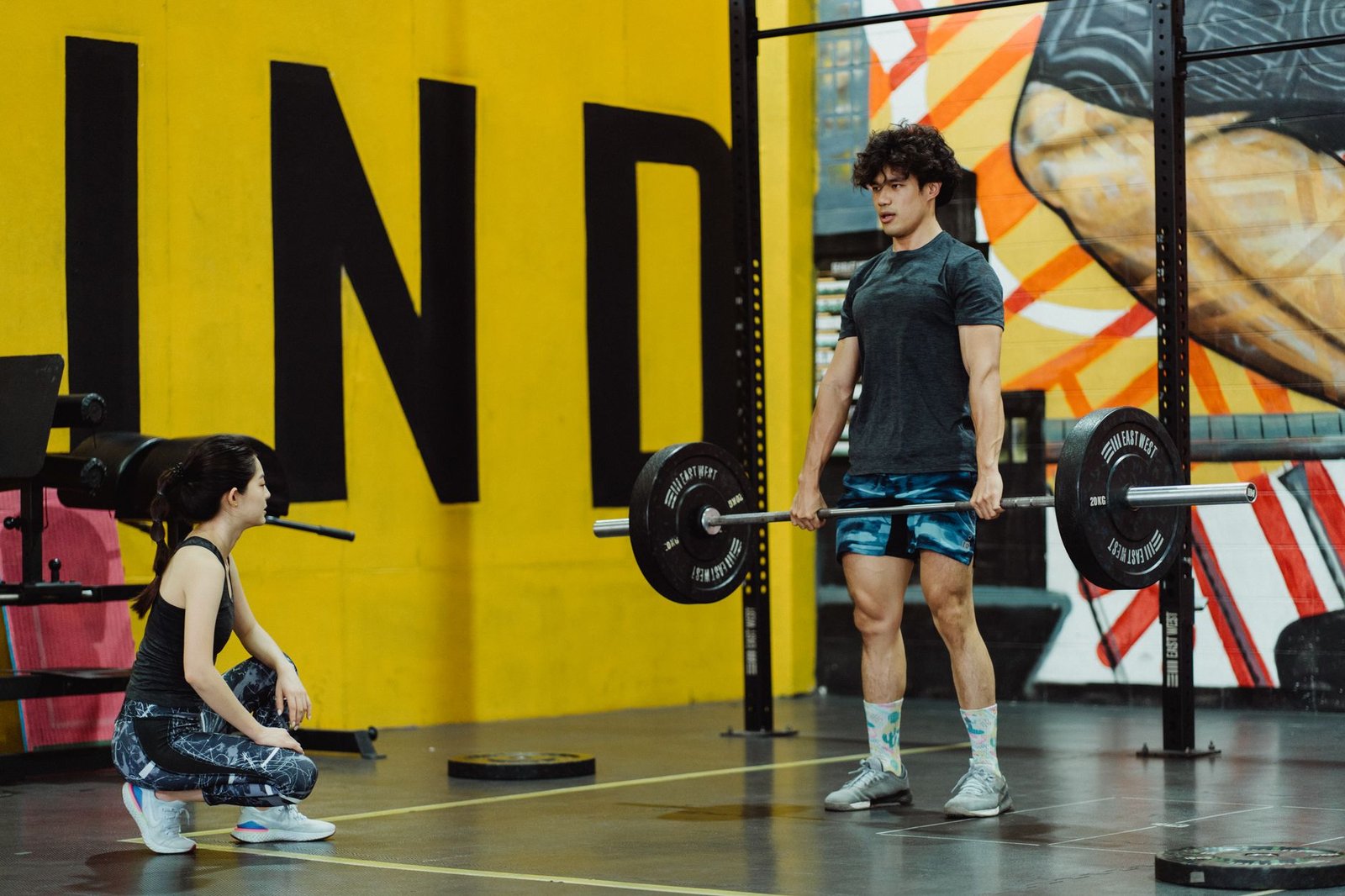
Romanian deadlifts train the hamstrings, glutes, and trunk while you control a loaded hip hinge. They fit distance running because they teach you to produce force from the hips while keeping the spine steady, rather than asking the knees to do all the work.
Use a barbell or dumbbells. Stand tall, soften your knees, push your hips back, and lower the weight until you feel strong tension in the hamstrings without rounding your back. Drive the floor away and finish with your hips, not by leaning backward. If the weight makes you bend your back or jerk the bar from the floor, it is too heavy for that day.
Runner performing a Romanian deadlift with a barbell
Single-Leg Control With Split Squats and Step-Downs
Split squats build force while one leg does most of the work. Keep your front foot planted, lower under control, and let the front knee track over the middle of the foot. They are the stronger loading choice of the two.
Step-downs demand more control than raw strength. Stand on a low step, lower one heel toward the floor, and use the working leg to return without letting the knee collapse inward. Begin with a 4-inch step if balance is poor, then raise it only when you can keep the pelvis level and the movement quiet. Use fewer repetitions if control breaks early. The goal is a stable landing and push-off, not a deep drop at any cost.

Runner in bright orange sneakers, showcasing energy outdoors.
Lower-Leg Strength With Two Calf Angles
Straight-leg calf raises train the gastrocnemius, but bent-knee calf raises may train the soleus more completely. The soleus takes high loads during distance running, so it deserves a place beside the larger leg exercises.
Perform one version with the knee straight and one with the knee bent if both fit your recovery. Move slowly through the full range, pause briefly at the top, and lower without bouncing. The calf work can follow heavy lower-body lifts, but reduce it if your next run feels affected.
Lateral Hip and Groin Strength
Copenhagen planks train the inner thigh and the side of the hip while your trunk stays braced. Support your upper leg on a bench, hold your body in a straight line, and use a bent-knee version first if the full position is too demanding.
Add two or three sets per side after the main lifts. Keep the hold short enough that your hips remain lifted. This work supports side-to-side control that running does not train well, but it should not leave your groin sore before a long run.
Add Plyometrics Without Spiking Training Stress
Plyometrics can improve how quickly you apply force, but jumping adds impact that your running plan already contains. Add it only after your current running week feels steady and your strength work no longer causes lingering soreness.
Place jumps before lifting if you include them in a strength session, because landing quality declines with fatigue. You can also place them after an easy run, provided the run is genuinely easy and the following day is not your long run or key speed session.
If you are new to jumping, use the lower end of the contact range in the table. A contact means one landing, so a set of ten pogo jumps gives you ten contacts. Start near that lower end when your calves, Achilles tendons, or feet are not used to repeated jumping.
Use simple movements first:
- Low pogo jumps with quiet landings
- Small squat jumps with a full reset
- Short skips with controlled rhythm
Add only 10 to 20 contacts after two or three sessions that leave your legs normal the next morning. Do not increase jump height and contact count together. If you raise the height, keep the number of landings unchanged.
Treat jumps as a separate power exercise, not as extra heavy sets. Stop when your landings become loud, your knees turn inward, or you lose the spring in each repetition. A few quality contacts may be more useful than a large fatigued block of jumping.

Athlete in blue tank top leaps over a hurdle on a track.
Adjust the Plan When Fatigue Changes Your Running
Normal fatigue often makes your legs feel heavy while leaving your stride intact. A problem appears when soreness changes how you run. Check during your warm-up and easy running for four signs:
- You shorten one side of your stride
- Your torso leans to avoid loading a leg
- Your foot lands heavily or farther in front
- Your knee, ankle, or hip moves inward on landing
If any of these changes persist after 10 minutes of easy running, do not complete the planned heavy lifting that day. Reduce the load, cut one or two sets, or replace the lower-body work with easy mobility and trunk exercises.
A small amount of soreness that fades as you warm up may not require a full change. Still, let the next key run guide the adjustment. If Tuesday’s lifting leaves you unable to run normally on Thursday, reduce Tuesday’s lower-body sets before changing the run.
Use this order when fatigue builds:
- Remove plyometric contacts first.
- Cut one set from each lower-body lift.
- Lower the weight while keeping clean repetitions.
- Move the session away from the next key run.
If your stride still looks different after those changes, stop the lower-body strength work and arrange an assessment with a sports medicine clinician or physical therapist. Resume only when you can walk and run without the altered landing, posture, or stride that caused you to cut back.
Measure What Carries Over
Strength-to-Running Integration for London: Building Power Without Overdoing It should be judged by what carries into your running, not by a bigger number in the gym. After each session, record the exercises, loads, and how your next easy mile feels in a training log.
Frequently Asked Questions
Can I begin strength training with only my body weight?
Bodyweight exercises provide a practical starting point if you are new to strength training or do not have gym equipment. Use them to practise controlled single-leg and trunk movements before adding external load.
How should beginners add bodyweight work to this plan?
Beginners can use bodyweight exercises as their initial strength sessions while they learn the movements. They can later progress to loaded versions once the exercises no longer provide enough challenge.
What if I cannot get to a gym during marathon training?
Bodyweight exercises let you keep a practical strength routine going without gym equipment. They are most useful as a starting point for maintaining basic strength practice when access to weights is limited.

I am Ozan, a London-focused running writer and marathon enthusiast with a passion for helping people discover the city’s best races, running routes, walking trails, and fitness events. I research and write practical, up-to-date guides covering marathons, race preparation, training tips, running gear, and everything related to staying active in London.
My goal is to create reliable, easy-to-follow content that helps runners and walkers of all experience levels explore London with confidence, whether they’re preparing for their first 5K or their next marathon.