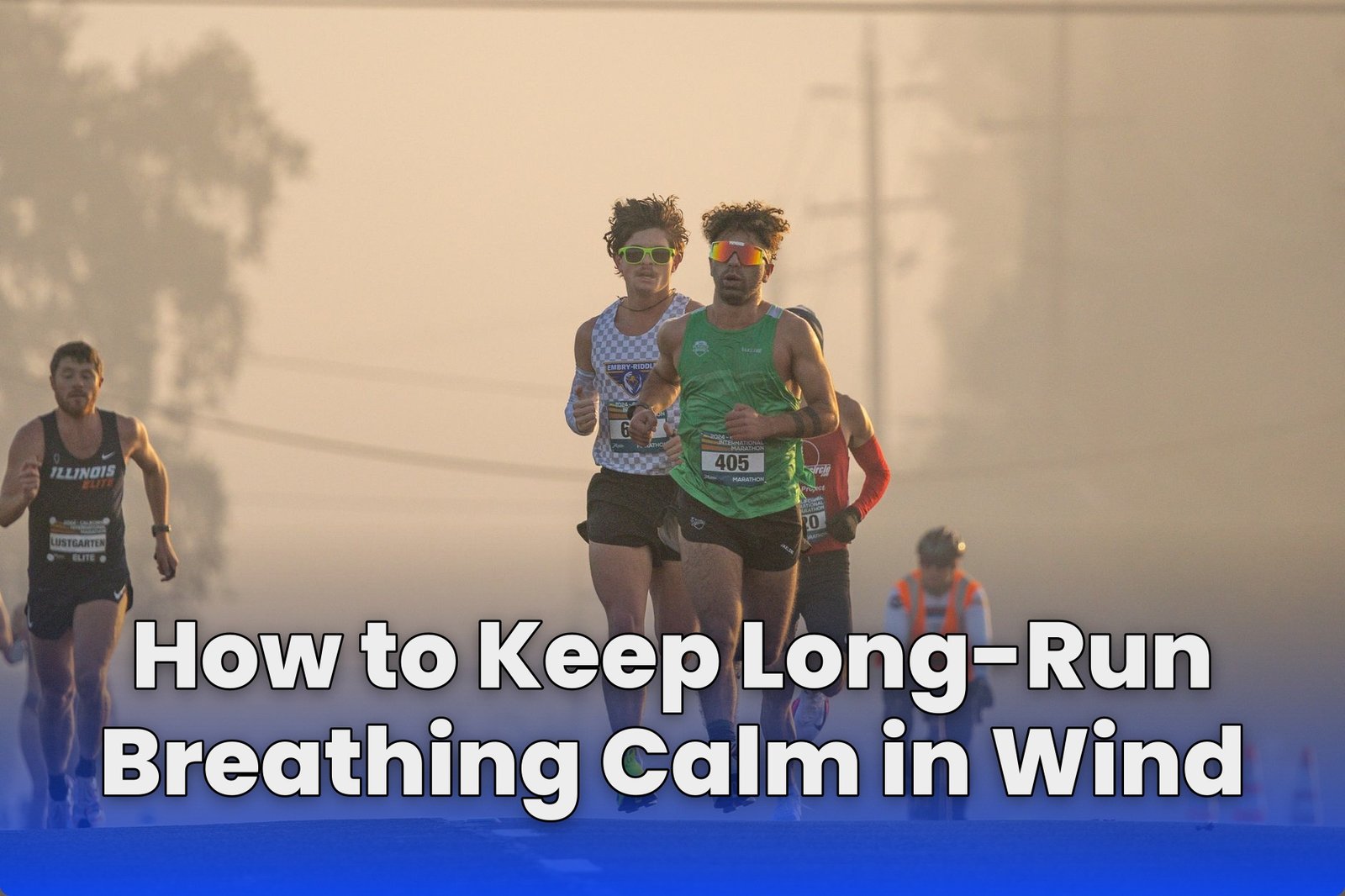
Long-run breathing stays relaxed in London wind when you slow to the effort, match your breath to your steps, and release tension from your shoulders and jaw. Your usual pace matters less than whether you can speak in short sentences without gasping.
A headwind can make an ordinary pace feel like a hard workout, especially on an exposed road or open riverside path. Start gently, accept a slower split, and let your breathing tell you when to build effort again.
The routine is simple: protect your first few minutes, run by controlled breathing, use a 3:2 rhythm as a starting point, and change it when the effort rises. Your route and running direction can make the same weather much easier.
Key takeaways
- Sheltered streets suit an easy long run; use exposed roads only when conditions are safe and you can accept a slower pace.
- Cold air feels harsh at the start, so cover your mouth with a buff and ease into the run until breathing settles.
- As effort rises, change from nose-only breathing to breathing through both your nose and mouth for more airflow.
- When the wind makes you tense, loosen your jaw, lower your shoulders and keep your posture tall; a relaxed upper body may make breathing feel easier.
Set Your Starting Effort for Wind and Cold
Before you leave, choose a route that gives you some shelter. Tree-lined streets, streets protected by buildings, and winding residential roads usually feel easier than an open waterfront path. If the forecast brings cold air, take a neck gaiter or buff that you can pull over your mouth for the first part of the run.
Have three things ready:
- A sheltered route for the opening miles
- A pace slower than your usual long-run split
- A buff or neck gaiter for cold air
Start more slowly than you planned. Give yourself about 10 minutes of easy running before you decide whether to increase the effort. Cold air can make the first breaths feel sharp, and a sudden headwind can make you tense before your body has warmed up.
Do not chase your usual pace while your breathing settles. You can add effort gradually once your breath feels regular and you can speak without breaking the sentence. A calm start protects the rest of the run.

Man jogging on city street crosswalk wearing a blue t-shirt and yellow watch.
Use the talk test as your first gauge. You should be able to say a short sentence, such as “I am keeping this easy today,” without stopping to gasp. If you can only get out a few words, slow down immediately instead of waiting for the next mile to improve.
Run by Breathing Effort Into the Wind
A headwind changes the work required to hold the same pace. The faster you move relative to the air, the more sharply that cost rises, so a strong wind can turn a modest pace adjustment into a much harder effort. That is why your breathing and perceived effort deserve more attention than your watch.
Let the pace fall when you run into the wind. A slower split is the correct result if it keeps the run aerobic. Forcing your normal pace can turn the first half of a long run into a workout that leaves you too tired to handle the return.
Use this check every few minutes on an exposed stretch:
- Say a short sentence aloud.
- Notice whether your exhale feels complete or rushed.
- Slow down if speech breaks or your breathing becomes uncontrolled.
- Build back gradually after the rhythm returns.
The pace may vary from one street to the next. That does not mean the run has gone wrong. Wind direction, gusts, clothing, hills, and shelter all change the effort while your watch records only speed.
A useful rhythmic breathing pattern can help you keep the breath tied to your foot strikes, but it should support an easy effort rather than force you to hold a pattern that no longer fits. If the wind makes you brace your body, shorten your stride slightly and reduce the pace until your breathing becomes quiet again.
Let the wind change your pace, not your effort.
Build a Smooth 3:2 Breathing Rhythm
For an easy long run, begin with a 3:2 rhythm. Inhale across three foot strikes, then exhale across two. The pattern gives you a gentle structure without asking you to control every breath.
Keep the breath continuous. Do not take three separate sniffs followed by two hard blows. Let the inhale flow while your feet land, then let the exhale finish naturally as the next steps arrive.
Try the pattern after your opening warmup, when your pace feels easy enough to speak. You can count quietly:
- Left, right, left while inhaling
- Right, left while exhaling
The count is a guide, not a test. If you need more steps per breath because the pace is very easy, allow that change. If the wind or a gradual climb makes the effort rise, your breathing may shorten without anything being wrong.
The pattern works best when your shoulders stay down and your jaw stays loose. If counting makes you rigid, stop counting for a minute, finish a long exhale, and return to a natural rhythm. The aim is steady breathing, not perfect arithmetic.

Man practicing relaxation outdoors with hands on chest and abdomen.
Practice this on a sheltered stretch before you need it in strong wind. Once the rhythm feels familiar, you can keep it through exposed sections without turning your attention away from the road, traffic, or footing.
Change the Rhythm When the Effort Rises
A 3:2 rhythm is a starting point for easy and long aerobic running. It is not a rule you must keep when the effort moves higher. On a hill, into a hard gust, or during a planned moderate section, you may need breaths more often.
A 2:1 rhythm can fit that situation. You inhale for two steps and exhale for one, giving you a quicker exchange of air. Use it briefly when the effort rises, then return to the easier pattern when the road levels or the wind drops.
The right choice depends on what your breathing is doing:
| Breathing option | Best effort | Step pattern | Airflow |
|---|---|---|---|
| 3:2 rhythm | Easy long run | Three in, two out | Nose or nose and mouth |
| 2:1 rhythm | Moderate effort | Two in, one out | Nose and mouth |
| Natural rhythm | Hard surge | Changes with effort | Nose and mouth |
Nose breathing can work during low-intensity running, especially on a sheltered road when your breathing feels easy. As the effort rises, breathe through your nose and mouth so you can move more air. Do not force nose-only breathing into a headwind if it makes you feel starved of air.
If your breathing becomes rushed, stop trying to speed up the inhale. Instead, make one complete, unhurried exhale. Then take the next breath naturally and lower your effort until the rhythm returns. If you cannot speak in short sentences after slowing down, end the hard section and return to an easy pace.
Keep the Body Loose While the Wind Pushes Back
Your breathing muscles work better when your upper body is not braced against the weather. Diaphragmatic breathing feels like an expansion around your belly and lower ribs as you inhale. Your upper chest and shoulders move much less.
You do not need to stop and perform a separate breathing drill. Check your body while running:
- Let your shoulders drop away from your ears.
- Unclench your jaw and keep your tongue relaxed.
- Keep your head level and your chest lifted.
- Let your arms swing without crossing tightly in front of you.
A tall posture gives your ribs room to move. It does not mean leaning backward or puffing out your chest. Keep a slight forward lean from the ankles, especially into the wind, while your neck and face stay loose.
Wind often creates a chain reaction. You lean too far, shorten your breath, tighten your jaw, and then mistake that tension for a lack of fitness. Release one part at a time. Start with the jaw, drop the shoulders, and make the exhale longer without forcing it.
If your lower ribs and belly expand while the shoulders remain quiet, you are closer to the breathing action you want. If your shoulders rise with every inhale, slow down for a minute and let your arms hang more naturally. The goal is a steadier breath, not a dramatic movement.
Choose a Wind-Smart Route and Run Direction
Your route can decide how hard the run feels before your breathing technique gets a chance to help. Open waterfront paths and broad roads expose you to gusts from several directions. Tree-lined streets and roads shielded by buildings break up the wind and give you short sections where your effort can settle.
| Route type | Wind exposure | Best use |
|---|---|---|
| Open waterfront path | High | Short exposed sections |
| Broad open road | High | Direct headwind practice |
| Tree-lined street | Lower | Long easy running |
| Building-shielded route | Lower | Cold or gusty days |
Choose shelter when you want an easy long run. Choose exposure only when the weather is safe and you can accept a slower pace. A route with several turns also lets you leave a punishing headwind instead of battling it for miles.
When possible, run into the wind on the outward leg and return with the wind behind you. You may work harder early, but you reduce the chance of meeting your strongest fatigue at the same time as the strongest headwind. Start slowly enough that the first section does not drain you.
Cold air needs a slower adjustment. Pull the buff over your mouth during the opening minutes, keep the first 10 minutes easy, and wait for your breathing to settle before adding pace. Remove the covering if it becomes damp or restricts your breathing.
Shelter also helps when the wind changes direction. Plan several short protected sections instead of one long exposed stretch, and use each sheltered part to regain a calm rhythm.

Person jogging along a foggy, tree-lined path surrounded by morning mist.
The best long-run route is the one that lets you finish with controlled breathing, even if your watch records a slower pace. Set out gently, follow the wind-smart direction, and let your effort decide the speed.
Make Your Breathing the Record
A slower pace in difficult wind still counts as a well-managed long run, and the most useful record is how steadily you maintained your breathing. Before your next run, write the wind direction on your route notes and compare it with the pace at which your breathing first becomes strained.
Frequently Asked Questions
Which wind direction is most common for London long runs?
London’s prevailing winds are mainly from the southwest and west, with average winter speeds at Heathrow reaching about 9.0 to 9.3 mph. A route that gives you shelter on those exposed sides can make the effort more predictable.
Can loose clothes make a windy run harder?
Loose clothing that flaps in gusts can increase aerodynamic resistance by up to 6% compared with more streamlined clothing. Secure layers that stay close to your body can therefore make exposed sections feel less wasteful.
Does a tailwind completely make up for the headwind on the way out?
No, a tailwind does not fully cancel the cost of an equivalent headwind. Classic running trials found that it returned about half of the energy lost into the headwind, so the return leg may still feel harder than expected.

I am Ozan, a London-focused running writer and marathon enthusiast with a passion for helping people discover the city’s best races, running routes, walking trails, and fitness events. I research and write practical, up-to-date guides covering marathons, race preparation, training tips, running gear, and everything related to staying active in London.
My goal is to create reliable, easy-to-follow content that helps runners and walkers of all experience levels explore London with confidence, whether they’re preparing for their first 5K or their next marathon.