A Saturday race changes what Sunday demands from you. Prepare for muscle damage, lower fuel stores, and slower recovery, then use pacing and recovery to limit how much those changes affect the second race.
Begin that preparation before race weekend. Build strength and controlled back-to-back running into normal training, taper before the event, and test every meal, gel, shoe, and clothing choice before race week. Race weekend is the wrong time to discover that a waistband rubs or a gel upsets your stomach.
Key takeaways
- Race fuel and clothing should be choices you have already tested in training, not first-time experiments on London race weekend.
- If Saturday leaves your legs heavy, start Sunday conservatively and ease off when your stride becomes uneven or you need to strain to hold pace.
- A half marathon may need carbohydrate during the race, so carry a familiar gel and use the timing and amount your training has shown you can tolerate.
- After Saturday, the first hour can affect how much you have available Sunday. Walk easily, use gentle mobility, and eat familiar carbohydrate rather than adding another hard workout.
Eight to Twelve Weeks Before Race Weekend
Hard running can leave your muscles sore because each stride includes eccentric work, where the muscle controls lengthening under load. Downhill running, fast finishes, and racing all place this demand on your legs. Add strength and jumping exercises early enough for your body to adjust before the weekend.
Use two or three strength sessions each week only if that fits your existing training. Keep the work controlled at first, then build gradually:
- Slow split squats and step-downs for the quads and hips
- Calf raises with a deliberate lowering phase
- Low-volume hops, skips, and short bounds
- Controlled hill running before you add hard downhill work
Plyometrics do not need to leave you exhausted. Start with 2 sets of 8 to 10 contacts per exercise once or twice a week, and stop if your landing becomes noisy or unstable. Place this work after an easy run or strength session, not before your key speed workout.
A comparable hard effort can make later repeated work less unfamiliar, but it does not replace sleep, food, or sensible pacing. Introduce repeated stress in small doses instead of saving the full shock for London.
Use controlled weekend efforts to teach your legs the pattern. For example, run a steady 45 to 60 minutes on Saturday and an easy 30 to 40 minutes on Sunday, keeping both below race intensity. Every third or fourth weekend can include a moderate finish on Saturday, but leave enough recovery before the next hard session.
Long Runs and Mileage in the Final Three Weeks
Your longest run belongs about three weeks before race day. That gives you time to absorb the training and repair small aches before Saturday arrives. A long run during the final few days leaves fatigue without enough time to gain fitness from it.
Tapering can help you reach the first start with less background fatigue, so Saturday does not consume the reserve you need the next morning. The training timeline is:
| Training Window | Main Hard Work | Long-Run Timing | Mileage Change |
|---|---|---|---|
| 8 to 12 weeks before | Eccentric strength and plyometrics | Controlled repeated efforts | Normal training build |
| About 3 weeks before | Longest training run | Longest run of the block | Normal training |
| Final 2 weeks | Shorter, easier running | No long run | Reduce total mileage |
| Final week | Mobility or yoga | No demanding long run | Keep mileage reduced |
Cut total running during the final two weeks, with the sharper reduction in the last week if your legs feel heavy or your usual easy pace feels forced. Use short easy runs to maintain your rhythm, then leave the demanding work behind.
Do not replace the missing mileage with hard cycling, a long hike, or extra intervals. That keeps the same problem under a different name. A simple final-week pattern might look like this:
- Run easy for 20 to 40 minutes on two or three days, depending on your normal schedule.
- Add 10 to 15 minutes of gentle mobility after one easy run.
- Use a short yoga session or relaxed stretching instead of a hard workout.
- Keep at least one full rest day before Saturday’s race.
If you have pain that changes your stride, stop trying to preserve the plan and see a sports medicine clinician or physical therapist. Tired muscles are expected; altered mechanics are a warning.
Race Fueling, Shoes, Clothing, and Race-Day Mindset
Practice your whole race routine during training. A gel that works at mile 10 in a solo run may feel different when you take it after a hard Saturday, so test it under effort and record what happened.
A half marathon can require carbohydrate during the race because stored fuel may not cover the full distance, especially if you run hard or start with low fuel. Plan carbohydrate during the race and practice the amount and timing on long or steady runs. A practical routine is to take one familiar gel around 35 to 45 minutes into the race with water, then repeat only if that matches what you have already tolerated. Keep the same race-day fueling routine in training and on race weekend.
Eat 2 to 4 hours before racing and choose familiar food such as oatmeal, toast, rice, a banana, or another meal you have already digested well before running. Do not add a new supplement, unusually large breakfast, or rich food because the London race feels more important than a training run.
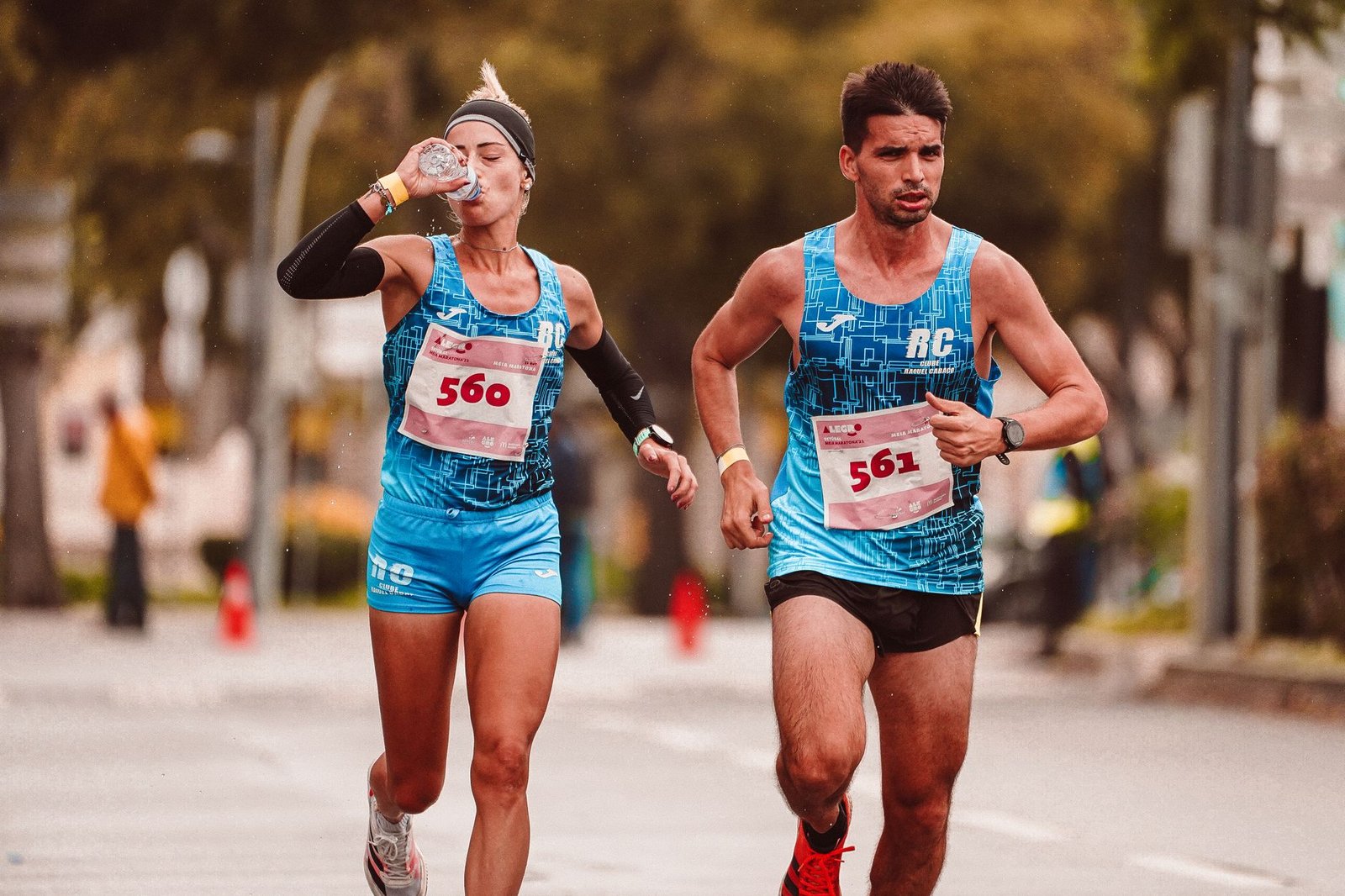
Two runners outdoors in a city, staying hydrated during the marathon.
The same rule applies to equipment:
- Wear shoes that have already handled several training runs.
- Check socks and clothing for seams that rub during long efforts.
- Apply petroleum jelly to spots that repeatedly chafe.
- Pack the exact gels, bottle, and clothing combination you plan to use.
New shoes can create blisters or fit problems when your feet swell over a long race. A pair that feels fine for a 20-minute jog has not earned race-day duty yet. Use it on several longer runs and inspect your feet afterward.
Build self-talk into the same practice. Choose two short cues, such as “relax the shoulders” and “hold this pace,” and repeat them when a run becomes uncomfortable. Positive self-talk is easier to use on Sunday when it has already become part of your training routine.
IMAGE[1]
Weekend Simulation Blocks
A weekend simulation should feel demanding but controlled. It teaches you how much effort Saturday leaves in your legs and whether Sunday’s plan still works when your stride is less springy.
Use the planned long-run volume as the reference, not the distance you hope to race. Put 60% to 75% of that volume on Saturday and 25% to 40% on Sunday. For a planned 12-mile long run, that means 7.2 to 9 miles Saturday and 3 to 4.8 miles Sunday. Keep the second day easy enough to preserve your mechanics.
Run the block several weeks before race weekend, not during the taper. One simulation at the start of the training phase can expose basic problems, while a later one can test your final fueling and clothing choices.
On Saturday, practice:
- The breakfast timing you will use before the race
- Your planned gel and water schedule
- The shoes and socks you expect to wear
- A controlled pace that leaves something for Sunday
On Sunday, start with tired legs and assess the choices rather than chasing a fresh-run pace. If your shoes cause a hot spot, your stomach feels unsettled, or your Saturday pace leaves you unable to run easily, adjust the training plan while there is still time.
A simulation also teaches restraint. Do not turn Saturday into a personal best and then call Sunday practice. The point is to rehearse the demand of two efforts, not to empty the tank before the real weekend.
After Saturday’s Race
The first hour can affect how much you have available Sunday. Walk easily for 5 to 10 minutes after finishing, especially if the race ends near the venue and you would otherwise sit down at once. Keep the movement relaxed and stop if you feel sharp pain, dizziness, or worsening stiffness.
Once your breathing settles, use gentle mobility. Move through ankle circles, easy leg swings, and a relaxed calf or hip stretch. Hold each stretch for about 20 to 30 seconds, without bouncing or forcing a tight muscle. Hard stretching on damaged tissue can make the next day feel worse.
Begin replacing carbohydrate soon after the effort. Aim for 1.0 to 1.2 grams per kilogram of body weight per hour for up to 4 hours after Saturday’s race. Spread the intake across meals and snacks if a single large meal feels difficult.
Carbohydrate works best alongside fluids and a normal protein-containing meal. Easy choices include:
- Rice or potatoes with a familiar protein
- Cereal, milk, and fruit
- A bagel with yogurt
- A sandwich with a sports drink
Do not use recovery food as an excuse to eat until you feel sick. Start with what your training has already shown you can handle, then eat again when your stomach feels ready.
Prepare Sunday’s kit before bed. Set out the shoes, clothes, number, gels, water, and breakfast so you do not spend the evening making decisions. A warm shower, quiet rest, and an early bedtime may help more than aggressive massage or another workout.

A fit man doing a yoga stretch indoors with an urban view behind him.
Sunday’s Race After Saturday Fatigue
Sunday begins with the routine you tested, not a new attempt to repair Saturday. Eat your familiar meal before the start, wear the shoes and clothing that passed your training checks, and carry the carbohydrate you have already practiced using.
Warm up less than you would for a single fresh race. Walk and jog easily, add a few relaxed mobility movements, and stop before the warm-up becomes a workout. Your legs may feel stiff at first. That does not mean you need aggressive stretching or a faster warm-up.
Change the purpose of your pacing. On Saturday, you may have chased a planned time. On Sunday, protect your stride and energy before you decide how hard to push. Start at a pace that feels controlled, then reassess after the early miles rather than trying to match Saturday’s splits immediately.
Use your practiced cues when fatigue rises:
- Relax your hands and lower your shoulders.
- Keep your steps short when your legs feel heavy.
- Take your planned gel with water instead of waiting for a crisis.
- Judge effort by breathing and form, not Saturday’s pace.
Slow down when your stride becomes uneven, your foot starts landing heavily, or you cannot keep your planned effort without straining. Walk briefly through a water station if that lets you regain control. Stop and seek medical help for chest pain, fainting, confusion, severe shortness of breath, or pain that changes how you run.
Use the Weekend as Evidence
A successful London race weekend gives you useful information even when Sunday feels slower than planned. The details that matter most are the moment your stride changes and the choice that helped you keep control. At your next simulation, mark the exact mile where your stride changes in your training log.
Frequently Asked Questions
Can I compete in person on both Saturday and Sunday of the 2027 London Double weekend?
No. London Marathon Events does not allow in-person participation on both days. You must complete the second day virtually through the TCS London Marathon MyWay app.
How long do I have to finish the Saturday race?
Saturday runners must finish within 7 hours 45 minutes. You need to reach the finish before the roads reopen at 5:30 p.m.
When is the Sunday finish deadline at Green Park?
Sunday competitors can finish at Green Park until 11:59:59 p.m. That gives you more flexibility to slow down or walk when Saturday fatigue affects your pace.

I am Ozan, a London-focused running writer and marathon enthusiast with a passion for helping people discover the city’s best races, running routes, walking trails, and fitness events. I research and write practical, up-to-date guides covering marathons, race preparation, training tips, running gear, and everything related to staying active in London.
My goal is to create reliable, easy-to-follow content that helps runners and walkers of all experience levels explore London with confidence, whether they’re preparing for their first 5K or their next marathon.