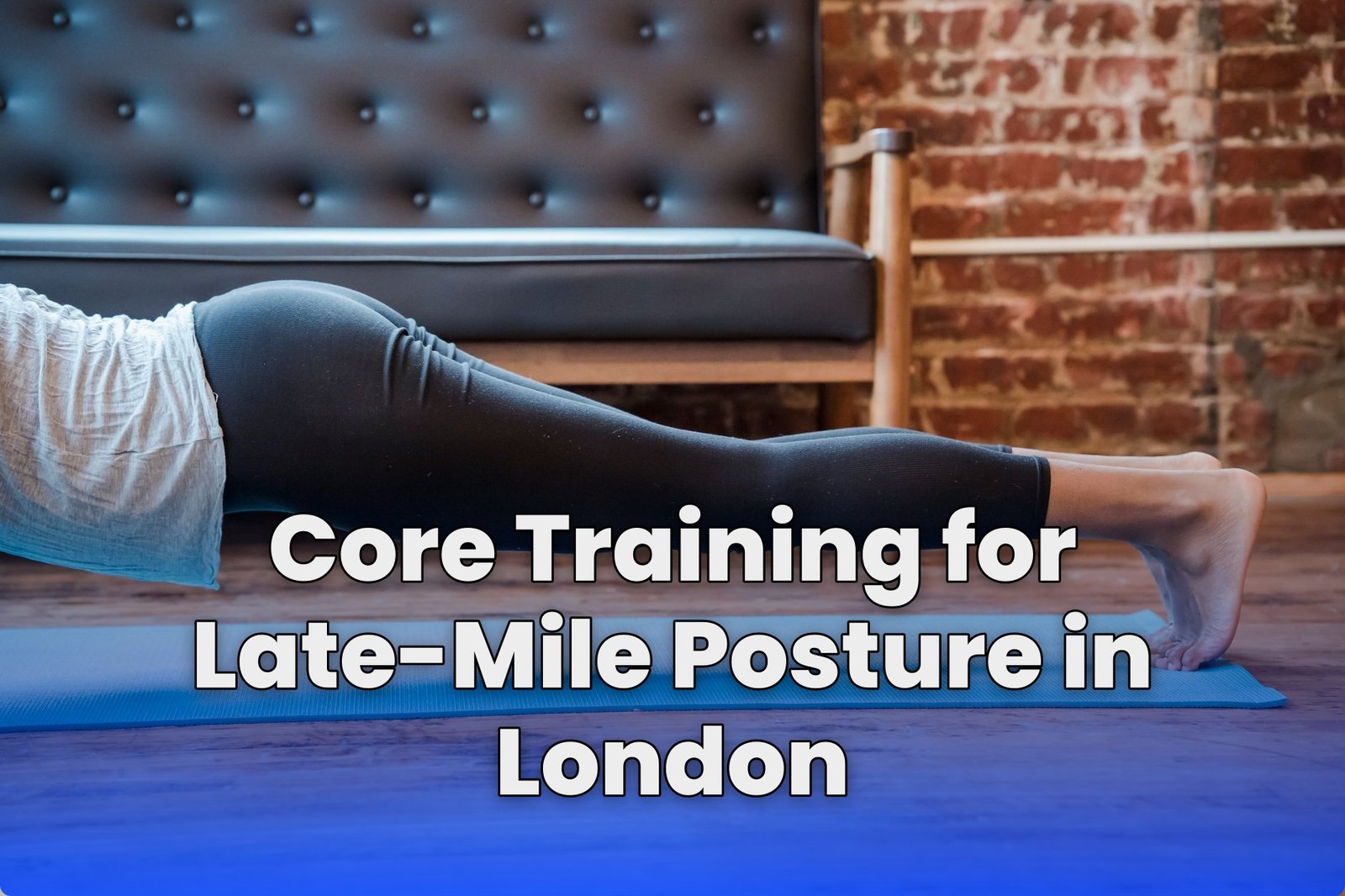
Late-mile hunching is a core problem, not a willpower problem. In London, the miles stack up fast, and fatigue makes your posture collapse into that rounded, up-and-down running feel. If you only stretch or rest, you will keep repeating the same slowdown pattern. The real fix is training your trunk and pelvis to stay organized when your legs start to go heavy.
The point of core work here is simple: control your pelvis, resist unwanted rotation, and keep your upper back strong enough to stay tall. You should practice neutral pelvic positioning with glute support, then add endurance in the lateral hips so your body does not “drop” as the run drags on. Pair that with upper-back strength and posture cues, like a slight forward lean from the ankles and “running tall” with relaxed shoulders, so your form stays efficient when late-mile fatigue hits.
This article will walk you through a focused routine built for the moment your posture starts failing. You will use bracing drills like dead bugs and planks, stability work like bird dog variations and side planks, and coordination moves that connect your trunk to your hips. Do it a few times a week, keep your hips level, and progress only when your form holds, and London roads will stop punishing you for being tired at mile seven or eight.
Stop Chasing Vanity Abs for Late-Mile Posture
Late-mile fatigue turns running form into a negotiation between your trunk and your hips. If your core training is just about burning time on planks, you are training endurance for your ego, not posture. The goal is simple: keep your spine stacked and your pelvis controlled when your stride starts to hunch.
Ask yourself: when fatigue hits, do you get “stronger” or do you just get “sloppier”? If you cannot hold neutral pelvic control and reduce vertical oscillation, no amount of sit-ups will fix the mechanics. That is why this plan is about posture under load, not ab vanity.
Build Pelvic Neutral With Transverse Control and Glutes
Your posture collapses when the pelvis stops cooperating. Train the transverse abdominis to resist unwanted trunk motion while the glutes support the pelvis. During late-mile fatigue, your job is not to arch harder. Your job is to keep the pelvis neutral and the trunk stiff.
Practice bracing that feels like “holding your midsection steady,” then let the run do the work. Use core-bracing drills like dead bugs and bird-dog reps where your hips stay level and your lower back does not start doing gymnastics.

Stabilize Lateral Hips so Your Torso Stops Swaying
Forward hunching is often treated like an upper-body problem, but lateral hip instability is a major driver. When your glute med and glute min endurance fades, the pelvis drops on one side, your torso compensates, and your stride starts to look like up-and-down motion.
Stabilize the lateral hips with side planks, banded side-steps, clamshells, and side-lying hip abduction. Keep form strict even when it gets uncomfortable, because the late-mile payoff depends on stability endurance, not one perfect rep.
Train Upper-Back Strength for Ribs That Stack
If your shoulders creep forward, your ribs follow. The result is that your posture cues become wishful thinking halfway through a run. You need upper-back strength that lets you stay tall while your legs get tired.
Use pulling work that targets lats, rhomboids, traps, and the erector spinae. Rows, chin-ups, face-pulls, and banded pull-aparts teach your trunk how to stay organized while your cadence changes. Your run posture improves when your upper back can resist rounding.
Own the 5 to 10 Degree Forward Lean From the Ankles
Let’s get specific. Late-mile “hunching” is not the same thing as a forward lean. A healthy running position uses a slight 5 to 10 degree forward lean from the ankles. If the lean comes from the hips instead, your torso folds and your core loses leverage.
During training, practice cues that keep the lean honest: “running tall,” shoulders relaxed, ribs stacked, arms bent around 90 degrees at your sides, and an engaged pelvis. During fatigue, use a tactile cue like “point your belly button slightly toward your knees.”
Posture is not a mood. It is a position you can reproduce under stress.
Turn Fatigue Into Cues and Mechanics You Can Repeat
Fatigue is predictable. It has a pattern: you start shifting into more up-and-down motion, you lose pelvic stiffness, and your trunk starts to chase the legs. Your training should rehearse the moment when control slips, then lock in the cue that restores it.
For a detailed breakdown of what core strength looks like when the runner is already fading, borrow the structure from core fatigue breakdown and map it to your own cues like forward ankle lean, ribs stacked, and quiet shoulders.
| Posture Attribute | Fatigue Cue | Core or Support Drill |
|---|---|---|
| Pelvic neutrality | “Belly button toward knees” | Dead bug bracing |
| Lateral hip stability | “Hips level” | Side plank |
| Ribs stacked | “Chest tall” | Pallof press |
| Upper-back control | “Shoulders quiet” | Band pull-aparts |
| Lean from ankles | “Lean from feet” | A-skips posture rehearsal |
How do you know the cues are working? Your stride should show less vertical bounce, your breathing should feel more organized, and your hips should not rotate or drop when you run tired. If you cannot reproduce the position in drills, you cannot demand it on the street in London.

This is also where many runners fail. They wait for the run to “fix itself,” then blame their core. Instead, train the cue-action link until it fires automatically when late-mile fatigue arrives.
Core Bracing Drills That Hold Form When You Shake
When fatigue hits, your trunk either braces or it collapses. Train bracing that survives shaking by using drills with clear constraints: slow, controlled reps and strict alignment. Dead bugs and planks should feel like trunk stiffness, not just muscular burn.
Progress only when form stays stable: hips level, lower back not arching, and breathing that does not inflate your ribs into a flare. If you can’t keep the pelvis quiet at rep 8, the set is not done. It is just unfinished.
Trunk-Lower-Body Coordination for Posture Under Load
Core endurance alone does not fix running mechanics if your trunk and legs do not coordinate. Late-mile fatigue is a coordination breakdown: the pelvis moves unpredictably as footstrike and cadence change, and the torso scrambles to catch up.
Use trunk-lower-body drills that train spinal control and timing. Slow quadruped pelvic tilts and cat-cow-style reps can help you feel the difference between controlled movement and collapse in the lower back. Keep the focus on control, not range.
Glute Max and Glute Med Work That Prevents Pelvic Drop
Pelvic positioning depends on glute strength and endurance. Glute max helps maintain pelvic alignment while you push through the stride. Glute med and min stabilize the hip so you do not rotate or drop the pelvis into a hunching pattern.
Build this with hip thrusts, glute bridges, step-ups or split squats, and RDLs. Pair them with lateral stabilizer work like cross-over step-ups and windshield wipers. Keep transitions short and rest minimal to target endurance for long runs, not a one-minute strength test.
Counter the Hunch With Pulling for Erector and Lats
Upper-back strength is not decoration. It is the counterweight to forward collapse. When your lats and mid-back fail under fatigue, your shoulders round, your ribs shift, and your spine loses stacked alignment.
Counter with rows and banded pull-aparts, chin-ups, and face-pulls. Train the pattern while your core is engaged so the body learns one integrated posture. When the upper back can pull you tall, your core does not have to fight for posture alone.
Cadence Drills That Preserve the Forward-Lean Running Style
Mechanics improve when you train your nervous system to hold the position at higher cadence. Late-mile fatigue often drags stride length and encourages an up-and-down gait. That shift increases vertical oscillation and pushes you into the hunched posture.
Practice drills like A-skips and high knees to rehearse the forward-lean feel. Higher cadence is not a magic switch, but it is a tool that helps you keep the forward ankle lean while your legs get tired.

- Rehearse cues during fast foot drills, not just strength work.
- Stop the drill when the lean turns into a hip fold.
A 10-Minute London Routine With Progression Rules
Here is a practical starting point for how to train your core for better posture during late-mile fatigue in London. Train 3 to 4 times per week with a tight 10-minute circuit that hits bracing, lateral stability, and pelvic control.
Do the following: dead bug 2 x 10 to 12 per side, bird dog 2 x 10 to 12 per side, plank 2 x 30 to 45 seconds, side plank 2 x 20 to 30 seconds per side, Pallof press 2 x 10 to 12 per side, and glute bridge 2 x 15 to 20 reps. If form holds, progress time or reps. If the hips drop or the lower back arches, you regress to earn control.
Street running in London brings steady demands: hills, uneven pavement, and wind that changes how you breathe. Your routine prepares you for those conditions by building the exact control you need when the late-mile fatigue shows up and tries to rewrite your posture.
How to Train Your Core for Better Posture During Late-Mile Fatigue in London?
How Can Core Training Improve Posture When Late-Mile Fatigue Causes Hunching?
Core training helps you control your pelvis and ribs so your torso stays tall when fatigue makes you round forward and shift into a more up-and-down motion.
Which Core Exercises Help You Maintain Pelvic Neutrality While Running in London?
Use bracing drills that teach neutral pelvis control, like dead bugs, planks, and bird dog variations, while you keep hips level and avoid arching the lower back.
What Hip Stability Work Reduces Pelvic Drop During the Last Miles?
Strengthen your lateral hips and glutes with exercises like glute bridges, hip thrusts, step-ups or split squats, and side-focused work such as side planks and banded side-steps to limit pelvic rotation.
How Should You Build Upper-Back Strength to Stay Tall When You Are Tired?
Add rowing and pulling work such as face pulls and pull-aparts to support an upright torso, with relaxed shoulders and ribs stacked over your pelvis during late-mile effort.
What Running Cues and Form Drills Prevent Vertical Oscillation When Fatigue Hits?
Practice a slight forward lean from the ankles and keep cadence quick with drills like high knees and A-skips, using cues such as “running tall” and “belly button toward your knees” as you tire.
How Often Should You Do a Core Routine to Handle Late-Mile Fatigue on London Routes?
Do a short routine about 3 to 4 times per week, focusing on dead bugs, bird dogs, planks, side planks, Pallof press, and glute bridges, and increase time or reps only when form stays steady.
Train Your Core Or Accept The Hunch
If you want how to train your core for better posture during late-mile fatigue in london, train the basics under stress: keep neutral pelvic control, steady the lateral hips, and strengthen the upper back so you can stay tall with a slight forward lean from the ankles when form starts to slip. Your runs will change when your core holds position under fatigue, not when you wait for willpower to kick in. Build it with a short 10 minute routine you repeat 3 to 4 times per week, then pair it with posture cues and higher cadence practice until the “up-and-down” motion stops taking over.

I am Ozan, a London-focused running writer and marathon enthusiast with a passion for helping people discover the city’s best races, running routes, walking trails, and fitness events. I research and write practical, up-to-date guides covering marathons, race preparation, training tips, running gear, and everything related to staying active in London.
My goal is to create reliable, easy-to-follow content that helps runners and walkers of all experience levels explore London with confidence, whether they’re preparing for their first 5K or their next marathon.