
Stop treating strength training like an afterthought. If you are a marathoner, you need strength that survives hills, fatigue, and bad weather, not a gym routine that fits only on perfect weeks. That is why a simple strength routine for marathoners using London parks and benches feels so right: it uses what is already nearby, and it keeps your training grounded in repeatable movement.
The problem is not that runners cannot get stronger. The problem is that most plans are either too complicated to keep consistent or too “general” to matter when the mileage stacks up. A bench and a path in a London park let you practice the patterns your running depends on, like squatting, hinging, lunging, bracing, and pressing or pulling, with just enough structure to progress week by week.
In this article, I will push for the kind of routine you can actually stick to: two strength sessions a week with deliberate progression, so your legs stay resilient and your core stays useful when form starts to slip. If you want a marathon build that feels practical on Monday and still holds up on race week, start here.
Marathon Strength Needs To Be Simple Enough To Repeat
The point of strength training for marathoners is not to suffer in a gym. It is to stay durable through long miles. A simple strength routine for marathoners using London parks and benches wins because it is repeatable, location-proof, and easy to schedule without turning training into a second job.
When you make the plan complicated, you make it fragile. You miss sessions, you lose momentum, and you blame the schedule instead of the design. The smarter choice is fewer movements, clearer progressions, and a setup that fits real life in the city.
Two Sessions Per Week With Real 48 Hour Spacing
Start with 2 strength sessions per week and keep at least 48 hours between them. That spacing is not a luxury. It is the difference between muscles adapting and muscles just absorbing. You want training effect, not constant fatigue stacking.
Do not guess. Pick two days that you can protect. If your marathon build is already tight, the rhythm matters more than the exact day name. Consistency beats cleverness every week of the year.
London Parks And Benches Are Enough Equipment
Stop waiting for a perfect facility. London parks and park benches offer stable, repeatable positions that work for squats, lunges, hinges, step-ups, and even upper-body pushing and pulling. A bench is height, leverage, and safety in one object.
Choose benches that are sturdy, non-slippery, and consistent in height. If you switch benches randomly, you change your range of motion. If you keep the same style of bench, your form improves and your reps become comparable.
Weekly Progression That Actually Matches Adaptation
Use a progression you can explain in one breath. Week 1 starts with 2 sets of 8 reps per exercise. Week 2 moves to 10 reps per set. Week 3 adds a 3rd set to the last three exercises. Then weeks 4 to 5 run 3 sets of 10 reps for each exercise.
This pattern respects how strength improves: practice the movement, add controlled volume, then consolidate. If you increase too fast, you pay with soreness and missed runs. If you increase too slowly, you waste weeks. This schedule lands in the workable middle.
Cover The movement Categories Like A Checklist
A marathoner needs strength across more than one plane and more than one joint action. That is why the routine is built around movement categories: squat, hip hinge, lunge, step, upper-body push or pull, brace or rotate, plus targeted strengthening. You are not collecting exercises. You are collecting functional coverage.
Ask yourself a blunt question. Are you stronger because you train, or are you just busy? When each session maps to those categories, your effort turns into structure. Structure protects your running mechanics when fatigue hits.
Strong legs are not enough. Strong hips, stable cores, and resilient upper bodies decide whether your stride stays efficient under load.
Bench Warm Ups Should Prep Joints, Not Burn Energy
A bench routine fails when you treat warm ups like a cardio test. Keep it 5 to 10 minutes and direct the work at preparation: light skipping or jumping, then dynamic stretches that match the session. That is how you get warm tissue without stealing your strength quota.
Then move to first-rep quality. Your first set should look like a rehearsal of the final sets. If your technique collapses early, your reps count less than you think.

Day 1 Bench Friendly Pattern For Knee Dominant Strength And Upper Support
In a typical Day 1 session, you do the warm up, then you build a squat and lunge foundation with bench assistance. A straightforward sequence looks like this: bodyweight or goblet squat (bench-assisted) for 2 to 3 sets of 8 to 10, lateral split squat for 2 to 3 sets of 8 to 10 per leg, and dead-leg step-up on the bench for 2 to 3 sets of 8 to 10 per leg.
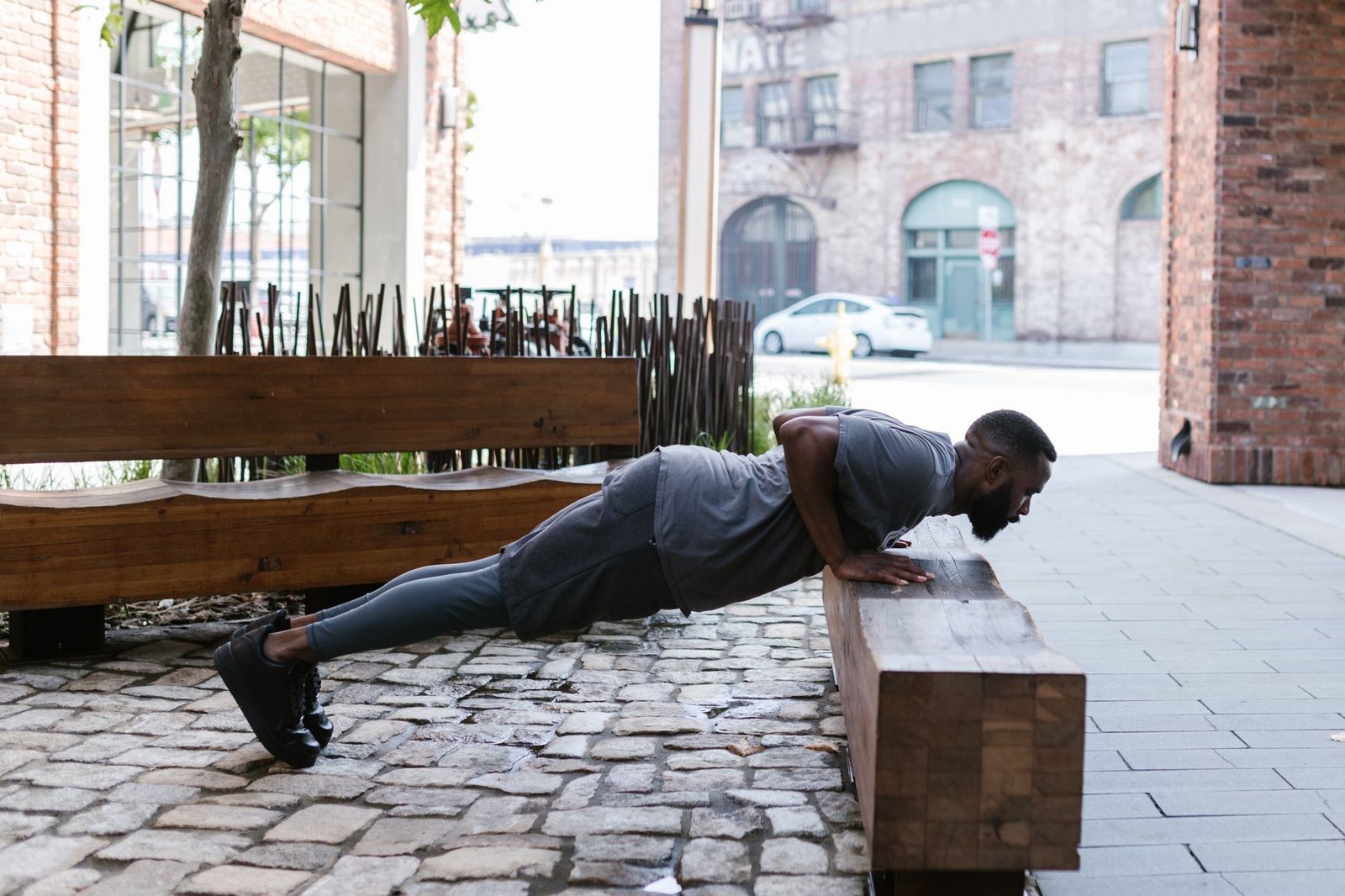
Finish with upper-body push and lower-leg support: press-up or push-up with hands on the bench for 2 to 3 sets of 8 to 10, calf raise for 2 to 3 sets of 8 to 10, and a side plank for 2 to 3 sets of 30 seconds per side. It is compact, it trains stability, and it pairs well with marathon running because it does not bury you in eccentric overload.
| Movement Category | Bench Variation | Weekly Rep Range |
|---|---|---|
| Squat | Goblet squat with bench help | 8 to 10 reps |
| Lunge | Lateral split squat | 8 to 10 reps per leg |
| Step | Dead-leg step-up on bench | 8 to 10 reps per leg |
| Upper Push | Bench press-up | 8 to 10 reps |
| Brace And Side Stability | Side plank | 30 seconds per side |
If you want visual bench angles and variations, park-bench guidance can save time when you are setting up your first session.
Day 2 Builds The Poster Chain And Rotational Bracing
Day 2 should feel different because the goal changes. After the same warm up, prioritize glutes and hinges: glute bridge or single-leg glute bridge for 2 to 3 sets of 8 to 10 per leg, split squat for 2 to 3 sets of 8 to 10 per leg, and a single-leg Romanian deadlift for 2 to 3 sets of 8 to 10 per leg.
Then add upper-body pulling and anti-rotation work: bench-supported inverted row or assisted pull-down or pull-up style pull for 2 to 3 sets of 8 to 10. Finish with side-lying leg raises for 2 to 3 sets of 15 per leg or kneeling superman for 2 to 3 sets of 8 per side, plus bench Russian twists for 2 to 3 sets of 8 to 15 per side.
Why this matters for marathoners? Because fatigue tends to reorganize your hips and ribs first. Strong posterior chain work and controlled rotation help you keep running posture when the end of the long run arrives.
Taper Weeks Reduce Volume Without Losing Sharpness
When you taper, you are not abandoning strength. You are reducing fatigue. In a taper week, cut the volume substantially, for example keep about 2 sets of fewer reps for harder elements like squat and bench jump style work, and shorten core and calf rep ranges.
The rule is simple: keep the key movement patterns sharp. If your session becomes a grind, it steals recovery. If it becomes a fast practice, you arrive at race week with better coordination and less stiffness.
Manage Soreness So Your Runs Stay On Track
Park and bench strength can still create soreness, especially when you start or when you add the third set. Do not treat soreness like a badge. Treat it like information. If you feel heavy on your next key run, you scheduled too much volume too soon or you trained with too much range of motion variation.
Reduce reps first, then sets. If technique slips, go easier. Marathon training already includes systematic stress. Strength should be a stabilizer, not another stressor that competes with your training plan.
Common Mistakes That Break The Routine
The routine fails when people chase load instead of control. A bench allows you to cheat yourself with sloppy depth. So set your range and repeat it. Do not swap the bench height every session. Choose a stable position and stay there.
Opponents argue that bodyweight and bench-only work is too limited for serious marathon goals. That view ignores specificity. Strength for marathoners is about joint control, tendon capacity, and resilience under fatigue. These patterns target those systems using progressive volume, not gym machines.
- Skipping the 48 hour spacing
- Adding sets every week without the planned jump
- Turning warm ups into extra workouts
Track Completion, Not Motivation, To Make It Stick
Marathoners do not need more inspiration. They need a system. Track what you completed: sets, reps, and which bench variation you used. If you miss a session, restart at the next logical week, not at your lowest point of confidence.
That tracking mindset is what turns a simple strength routine for marathoners using London parks and benches into a durable habit. You do the work because you can see the pattern, not because you feel like it.
A Simple Strength Routine for Marathoners Using London Parks and Benches
How Do You Schedule Strength Sessions for a Marathoner Using London Parks and Benches?
Plan two strength sessions per week with at least 48 hours between them, so legs and upper body recover before your next run-focused day.
Which Movement Categories Should You Cover When Building Strength Workouts in London Parks?
Each week, cover squat, hip hinge, lunge, step, upper-body push or pull, and a brace or rotation pattern, then add targeted strengthening that supports your marathon needs.
What Should Weeks 1 and 2 Look Like in a Simple Bench-Based Strength Routine?
Start in week 1 with 2 sets of 8 reps per exercise, then in week 2 move to 2 sets of 10 reps per exercise while keeping the same movement categories.
How Do You Progress From Weeks 3 to 5 With Park Bench Strength Sessions?
In week 3, add a third set to the last three exercises in the workout, then use weeks 4 to 5 for 3 sets of 10 reps for each exercise.
What Are Example Day 1 and Day 2 Workouts Using London Benches?
Day 1: warm up 5 to 10 minutes, then do bench-assisted bodyweight or goblet squat 2 to 3 sets of 8 to 10, lateral split squat 2 to 3 sets of 8 to 10 per leg, dead-leg step-up on the bench 2 to 3 sets of 8 to 10 per leg, push-up or press-up with hands on the bench 2 to 3 sets of 8 to 10, calf raise 2 to 3 sets of 8 to 10, and side plank 2 to 3 sets of 30 seconds per side. Day 2: warm up 5 to 10 minutes, then do glute bridge or single-leg glute bridge 2 to 3 sets of 8 to 10 per leg, split squat 2 to 3 sets of 8 to 10 per leg, single-leg Romanian deadlift 2 to 3 sets of 8 to 10 per leg, bench-supported inverted row or assisted pull-up style pull 2 to 3 sets of 8 to 10, side-lying leg raise 2 to 3 sets of 15 per leg, and bench Russian twists 2 to 3 sets of 8 to 15 per side.
How Should You Modify the Routine in a Taper Week While Training With London Parks and Benches?
Reduce volume substantially in taper weeks, such as fewer sets and smaller rep ranges for core and calf work, while keeping the main squat, hinge, lunge, step, push or pull, and brace or rotation movements sharp.
Stick With What Works
A simple strength routine for marathoners using london parks and benches should stay simple, repeatable, and pattern based: train twice a week with at least 48 hours between sessions, hit squat, hip hinge, lunge, step, push or pull, and brace or rotate, then taper by cutting volume while keeping form sharp. When you use benches and park space like your equipment and treat strength as maintenance for your race, you build resilience without wrecking your legs, and you earn steadier long runs instead of guesswork.

I am Ozan, a London-focused running writer and marathon enthusiast with a passion for helping people discover the city’s best races, running routes, walking trails, and fitness events. I research and write practical, up-to-date guides covering marathons, race preparation, training tips, running gear, and everything related to staying active in London.
My goal is to create reliable, easy-to-follow content that helps runners and walkers of all experience levels explore London with confidence, whether they’re preparing for their first 5K or their next marathon.