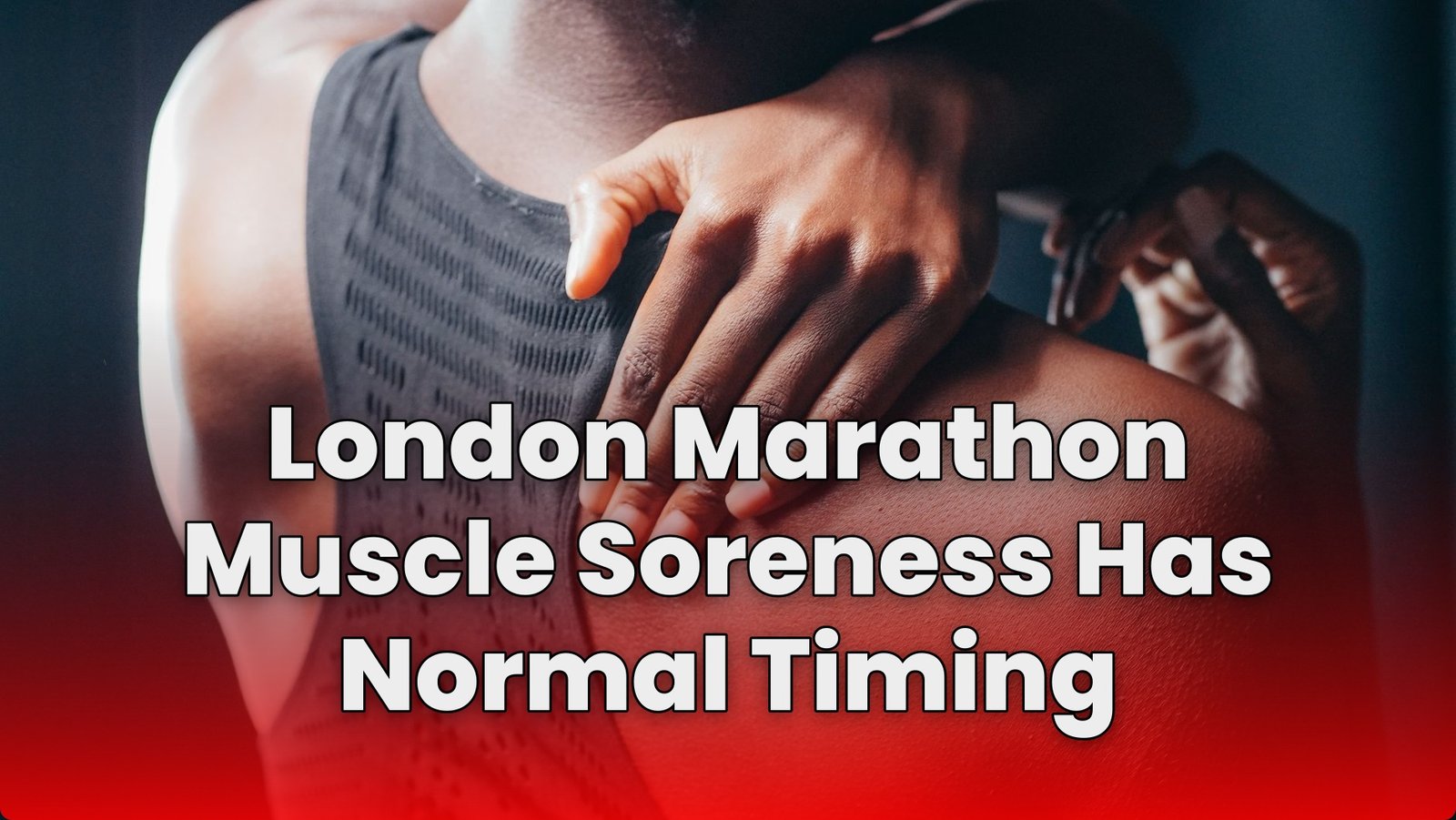
London Marathon muscle soreness is usually just delayed-onset fatigue, not a warning sign. The tricky part is that runners often expect pain to hit immediately after the finish, then panic when it shows up later. Delayed muscle soreness commonly starts about 1 to 3 days after the race, peaks roughly 24 to 48 hours after the marathon, and then gradually eases as your body repairs the unaccustomed load.
So how long is normal? Most people should see clear improvement within about a week, with many recovering fully in 1 to 2 weeks, even if some tightness lingers longer. During that window, your best strategy is a short recovery break from impact running, typically around 5 to 7 days (or up to about 7 to 14 if symptoms are still clearly present), plus low-impact movement like walking, cycling, swimming, and gentle stretching. When soreness is clearly settling, very easy, short runs near the end of that period can help, but rebuild gradually over the following couple of weeks instead of jumping straight back to marathon-level volume.
When should you worry? You should get checked if the pain is sharp or pinpointed to one joint, tendon, or bony spot rather than generalized dull ache, if it keeps worsening instead of plateauing, or if you see no improvement at all after roughly 7 to 10 days. Red flags also include significant swelling in one area, an inability to bear weight or persistent limping beyond a few days, fever or signs of infection, or “bone” pain that raises suspicion of a stress fracture. In other words, trust the usual timeline, but don’t ignore symptoms that look localized, progressive, or systemic.
London Marathon Muscle Soreness Is Supposed To Wait
After the London Marathon, london marathon muscle soreness often feels delayed, not instant. That is normal. Most runners notice soreness and stiffness starting about 1 to 3 days after the race, then feeling it most around 24 to 48 hours later.
If your legs get sorer on day 2 or day 3, you are not failing. You are watching the typical pattern of delayed onset muscle soreness, driven by the unusual eccentric load of marathon running. Would you expect a system to immediately calm down after a new, heavy stress?
Peak Soreness Usually Hits Around Day Two
The peak window matters because it sets your expectations and your decision-making. In the usual timeline, symptoms often climb through the day after the race, then flatten as the most inflamed tissue settles. That is why runners who “push through” peak soreness often end up feeling wrecked later.
Think of it like a storm schedule. If the worst hours arrive around 24 to 48 hours post-race, then your plan should protect you during that window, not demand heroics from your body.
How Long Is Normal For DOMS
For most people, the soreness improves within a week and often resolves fully in 1 to 2 weeks. Lingering tightness can persist a bit longer, especially in calves and hamstrings, even when the sharp ache is gone.
Use the timeline as a reality check. If the pain follows the normal arc and steadily trends down, it is usually DOMS. If it stalls, intensifies, or localizes to one exact spot, then normal becomes an unsafe assumption.
Rest Means No Impact Running For 5 To 7 Days
It is tempting to treat soreness as a permission slip for more running. Don’t. Most runners do best with a recovery break from impact running for about 5 to 7 days, and many coaches suggest a more cautious 7 to 14 day listening window when recovery feels slow.
Instead, choose low-impact movement early, like walking, cycling, swimming, or gentle stretching. Early motion can reduce stiffness and keep you mentally engaged, but it should never feel like training.
Active Recovery Helps More Than “Toughing It Out”
When soreness is peaking, your goal is not athletic improvement. Your goal is blood flow, comfort, and pacing your nervous system back toward normal. Light activity can help you stand up straighter and move more smoothly, even if the muscles still feel tender.
Use a simple rule: easy and short is allowed, hard is not. If you feel worse later the same day or the next morning, you did too much.
Use A Day-by-Day Reality Checklist
To stop guessing, track symptoms in a practical way. One day-by-day checklist can keep you from making two common mistakes: rushing back too soon or ignoring a warning sign. Progress is not complicated if you measure it.

| Time After Race | What Most Feel | Best Recovery Focus |
|---|---|---|
| 0 to 1 Days | Stiffness after effort | Walk, easy mobility |
| 1 to 3 Days | Soreness ramps up | Rest, low-impact |
| 24 to 48 Hours | Peak tenderness | Gentle movement only |
| 4 to 7 Days | Improvement begins | Easy recovery routine |
| 1 to 2 Weeks | Mostly back to normal | Gradual rebuild |
And if you are reading this while your legs feel at their worst, remember: that is often the expected phase, not evidence that something is broken.
When To Worry About DOMS That Won’t Move
Here is the hard truth: normal DOMS has a direction. It hurts, it peaks, and then it improves. If soreness does not improve at all after about 7 to 10 days, treat that as a decision point, not a minor annoyance.
Runners who recover the usual way often describe a clear turning point. If your recovery stalls, your best next step is getting assessed. For a clear explanation of the delayed timeline, see marathon recovery guide.
Sharp Pain At One Spot Is Not “Just Soreness”
General dull ache after a marathon is one thing. Sharp pain or pain that is localized to a single joint, tendon, or bony spot is another. DOMS can make muscles feel tender, but it should not feel like a pinpoint injury.
If you can trace your pain with one finger, take it seriously. That pattern is how many overuse injuries announce themselves, and guessing wastes time.
Stress Fracture Signals You Shouldn’t Ignore
Marathon training stresses bone as much as muscle. If you suspect a stress fracture, the timeline can be deceptive. Persistent “bone” pain that does not settle like typical DOMS is a major warning sign.
What does that look like in real life? Pain that keeps returning, hurts with weight-bearing, and does not follow the usual week-long improvement. When it feels bony and stubborn, your recovery plan should shift from training to evaluation.
Swelling, Limping, And Fever Are Red Flags
Some symptoms are not a “wait and see” scenario. Get medical evaluation if you develop significant swelling in one specific joint, you cannot bear weight or you keep limping beyond several days, or you have fever or signs of infection.
And if something feels system-wide, do not negotiate with it. Chest pain or difficulty breathing are emergencies, not recovery setbacks.

Gentle Stretching Is Fine, Aggressive Work Is Not
Stretching and light mobility can reduce stiffness, especially after low-impact walking. But aggressive stretching, deep massage, and painful foam rolling can turn recovery into re-injury when tissues are still sensitive.
Adopt a comfort threshold. If your stretching increases sharp pain and the next day is worse, back off. Recovery should leave you better, not just more inflamed.
Gradually Rebuild Over 2 To 4 Weeks, Then Return Fully
Once soreness is clearly settling, some runners can consider very easy, short runs near the end of the rest window. Then rebuild gradually over the next 2 to 4 weeks, focusing on tolerance and calm effort rather than pace.
Many runners need about 6 to 8 weeks for a full return to normal training after a marathon. Why rush? Because fitness comes from consistency, and consistency comes from staying healthy.
Your Mindset Should Track Reality, Not Anxiety
After the London Marathon, your brain will try to turn every twinge into a prediction. That is how runners either ignore real injury signals or panic through normal DOMS. The winning approach is grounded: watch the pattern, measure change, and respect warning signs.
Ask yourself daily what is improving, what is stable, and what is worsening. London Marathon muscle soreness often follows a predictable curve. When your body stops following the curve, that is your cue to act.
Does London Marathon Muscle Soreness Last This Long, and When Should You Worry?
How Long Is Normal for London Marathon Muscle Soreness After the Race?
London marathon muscle soreness from DOMS usually starts about 1–3 days after the race, peaks around 24–48 hours later, and typically improves within a week, often resolving fully in 1–2 weeks, though mild tightness can linger.
Why Does London Marathon Muscle Soreness (DOMS) Hit Days Later?
Marathons can create unusual stress on muscles, especially from eccentric loading during downhill running and braking, which causes micro-damage and an inflammatory response that often appears as delayed onset muscle soreness 1–3 days post-race.
How Long Should I Avoid Impact Running With London Marathon Muscle Soreness?
Most runners should take a recovery break from impact running for roughly 5–7 days, and if soreness is still significant, a more cautious window of about 7–14 days; during that time, choose rest plus low-impact activity like walking, cycling, swimming, and gentle mobility.
When Should I Worry About London Marathon Muscle Soreness Instead of Normal DOMS?
You should worry if pain is sharp or clearly localized to one joint, tendon, or “bone” spot rather than generalized dull soreness, if symptoms are worsening instead of plateauing, if there is little to no improvement after about 7–10 days, or if you have significant one-joint swelling, fever or infection signs, inability to bear weight, or concern for a stress fracture.
What Helps London Marathon Muscle Soreness Recover Faster Safely?
To help recovery, prioritize sleep and hydration, keep moving with easy walking and light low-impact work, use gentle stretching or yoga, consider easy mobility and light massage, and return to training only when soreness is clearly settling; avoid aggressive stretching if it sharply increases pain.
How Long Until I Can Return to Normal Training After London Marathon Muscle Soreness?
For many runners, full return to normal training takes about 6–8 weeks: after the initial recovery, restart with very easy, short sessions near the end of the first soreness-improving period, then gradually build intensity and volume over the following weeks.
Know What’s Normal And Spot The Red Flags
London marathon muscle soreness, how long is normal and when to worry boils down to this: delayed onset muscle soreness is expected to start 1 to 3 days after the marathon, peak around 24 to 48 hours, and typically settle within a week, with most runners feeling back to baseline in 1 to 2 weeks. If your pain is steadily easing but keeping you stiff, rest and low impact recovery are the right move, then rebuild gradually over the next weeks. But if soreness turns sharp or pinpoint, worsens instead of plateauing, lasts beyond about a week without improvement, or you see warning signs like significant swelling, fever, inability to bear weight, or persistent “bone” pain that could signal a stress fracture, do not wait around. Trust the timeline for DOMS, and act fast when your symptoms do not follow it.

I am Ozan, a London-focused running writer and marathon enthusiast with a passion for helping people discover the city’s best races, running routes, walking trails, and fitness events. I research and write practical, up-to-date guides covering marathons, race preparation, training tips, running gear, and everything related to staying active in London.
My goal is to create reliable, easy-to-follow content that helps runners and walkers of all experience levels explore London with confidence, whether they’re preparing for their first 5K or their next marathon.